
It’s important that you watch it all the way through if you want to fully understand the opportunities emerging in the space sector , as well as how you can join our exclusive Master’s program for engineers looking to orient their careers in this field.
The Master JSNP 12 Cohort is a 6-month program, fully online and delivered in English. It is designed to be compatible with your studies or current job, with all content accessible anytime, from anywhere, through our e-learning platform.
We look forward to seeing you in the selection process !
During the event, you saw how the space sector—especially technologies based on Satellite Navigation & Communications (SatNav/SatCom)—is experiencing unprecedented growth.
Companies in the industry are facing a common challenge: they cannot find sufficiently well-prepared engineers. At GNSS Academy, we train and support engineers so they can acquire the real technical skills demanded by the space industry.
Our objective is clear: to help you boost your career and position yourself to work in any of the companies we collaborate with—companies that trust our students because they know they are prepared to tackle real-world challenges, not just theory.
The JSNP Master is built on 5 MAIN ROCKS, which ensures that an engineer graduates ready to work in a company from day one, thanks to the acquisition of skills that even engineers with 10+ years of experience in the industry often lack.
For example, companies like Thales Alenia Space and Airbus or Safran enroll engineers from their own teams, with over 10 years of experience—into our Master because they know that in just 6 months, those professionals will be able to contribute more effectively and win more project bids.
Thanks to this Master, you’ll be able to collaborate in projects related to GNSS/SatNav technology systems, as well as Space Sustainability (SSA), Space Exploration (Moonlight / NovaMoon), LEO Constellation Design (LEO-PNT), Flight Dynamics (FD, POD), Receiver design for civil/military applications (PRS), Control Centers (Galileo GCS), Service Centers (GSC, GSMC, SAR), Reference Centers (GRC), and many other sectors that rely on satellite signals for positioning—such as aviation, drones, maritime, robotics, rail, autonomous vehicles/taxis, agriculture, and more.
Or even launch your own company or startup, offering a product or service that solves a real-world problem (e.g., drones, robots for fire response, farming, cadastre, events, delivery, etc.)—as several former students have done after completing the Master.
This Master is your entry point into the space sector, thanks to its specialization and the deep technical knowledge and strategic vision it provides across multiple areas.
The JSNP™ theoretical foundation is one of the core pillars of the program.
It’s structured into 5 main Blocks totaling over 300 hours of technical content
Foundations for understanding any space-based navigation system:
Global overview of navigation technology
Global/Regional/Augmentation constellations
System architecture & receivers
Reliable and precise positioning techniques
Observables and measurements: Code / Phase / Doppler / SNR
Error sources and correction models
Orbits & Atomic Clocks
Atmospheric propagation: Ionosphere, Troposphere
Position and time computation, basic estimation filters
Advanced techniques used across the industry:
Reliability and safety for critical applications
Differential techniques (with reference stations)
Centimeter-level precision methods
Resilience techniques: SatNav/Inertial Sensor Fusion
Advanced estimation filters (e.g., Kalman Filters)
Satellite signals must be received and processed by receivers—signal processing is thus crucial for mission success:
Signal definitions and properties
Receiver signal processing
Antennas and RF front-end
Acquisition & tracking techniques
Signal authentication: Galileo OSNMA / SAS
Threats: interference & spoofing
Signal simulators
A deep dive into European space systems:
Ground Segment architecture: Galileo and EGNOS
Validation and pre-processing algorithms
Orbit Determination algorithms (POD/OD&TS)
Clock synchronization and time scales
Ionospheric estimation algorithms
System integrity and fault detection
A special extra module to explore what’s coming next:
Future projects and trends
LEO-PNT / Alternative PNT
Lunar Navigation (Moonlight)
Signals of Opportunity
and more…
Alongside the theory, you’ll participate in workshops, each designed to build real, applied technical skills:
Python Language & Env. Set up
Best programming practices
Configuration Management – Git
Statistics, Distributions & Noises
Estimation Filters (LSQ, KF)
Orbit Dynamics
Linux shell scripts / Automation
Cloud / Virtualization / Dockers
Coordinate Systems and Time Scales
Sensor Fusion: GNSS/INS
Galileo HAS: High Accuracy Service
RTK Scenarios with RTK Lib
Signals Acquisition with Python
Signals Tracking with Python
Signals Simulations with Skydel
Interference/Spoofing Resilience
Galileo Authentication OSNMA/SAS
C/C++ Programming
Machine Learning
Satellite Performances
Ionosphere Performances
User Performances
These workshops are truly the most transformative part of the Master: they turn theoretical knowledge into real, industry-ready skills.
The key difference between someone who has «studied GNSS» and someone who is «ready to work» lies here.
The JSNP Master includes the development of a real end-to-end project, following ESA standards and industry workflows:
Professional Work-Packages: Requirements, Architecture, Design, Algorithms, Interfaces, Implementation & Validation
Technical documentation and deliverables
Full Python implementation
Result evaluation & validation
Real-data processing campaigns
Sample project topics include:
LEO-POD (Low Earth Orbit Precise orbit determination)
SBAS (Reliable positioning engine for aviation)
PPP (Centimeter-level precision positioning engine)
GNSS/INS sensor fusion simulator
Signals Processing
and more …
Your project becomes your professional weapon, something to defend in interviews, show code, explain your technical choices, architecture, methodology, and final performance.
You learn from engineers with 10–20 years of experience at leading companies like:
ESA, EC, EUSPA, GMV, Indra, Telespazio, Airbus, Thales Alenia Space, Xona Systems, Septentrio, INECO, DLR-Gfr, and others.
These experts lead masterclasses in:
Integrity & reliability
Orbit and clock algorithms (POD)
Signal processing in receivers
Resilience, cybersecurity, authentication
Interference, jamming, spoofing
Systems engineering for space projects (AGILE)
Advanced Galileo services
And more…
Often, they even share job openings in their teams for students who want to join their real-world projects.
This knowledge doesn’t exist in books or on YouTube. It only exists inside the industry.
Access to the JSNP™ eSchool
Over 250 hours of recorded content, structured into modules that you can study at your own pace, with timed block releases to ensure group progress. Includes webinars and expert classes from previous editions.
Live classes on Mondays and Wednesdays ( 7PM–9PM CET)
All sessions are recorded and available on the platform. Sessions include Theory, Workshops, Project, or Expert Talks depending on the week.
Individual and Group Tutoring
Available throughout the week with multiple time slots. Used to resolve:
Project blockers
Theoretical questions
Programming practices
Any other questions
Weekly planning
Technical discussion channels (project/theory)
Peer support
Direct contact with the teaching team
International networking
Job opportunities
Industry news and updates
This is a key part: It’s not enough to know you must know how to position yourself.
That’s why the Master includes a full Career Preparation module, where you’ll learn:
How to build a technical CV for the space sector: presenting algorithms, metrics, impact, and projects
How to build an optimized LinkedIn profile to attract top opportunities
LaunchPad: A strategy to position yourself within 3–6 months using our proprietary ILOD™ method
Access to the AGORA platform: GNSS Academy’s talent database that connects candidates with companies (it doesn’t guarantee a job, but greatly improves visibility)

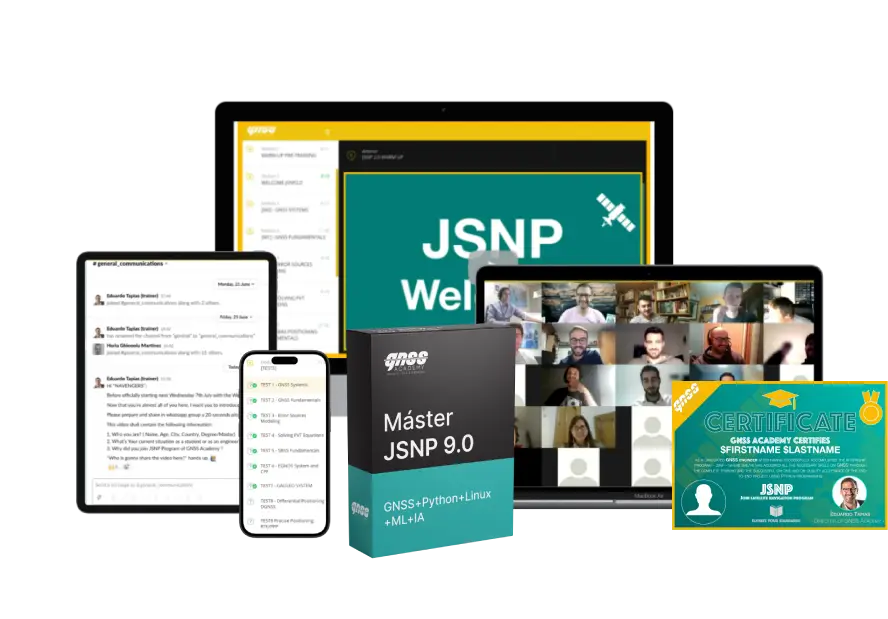
In this Master, you will learn essential disciplines of the space sector that are often difficult to acquire at university. They are taught by experts with more than 20 years of experience in leading companies in the sector, who will guide you throughout the program. Here is an overview of the school, which you will be able to access to review and learn everything you need.
Welcome to the JSNP Master™
The world’s leading training program in Satellite Navigation
It is an honor to welcome you to a new edition of the JSNP Online Master, a unique program that opens the door to some of the best career opportunities in the space sector.
More than 500 engineers from 38 countries, aged between 20 and 60, with very diverse backgrounds, have successfully completed this program. Today, most of them working in key companies within the space industry, directly applying the skills acquired during the training.
The market is experiencing exponential growth: high-precision positioning systems for drones and autonomous vehicles, new generations of GNSS services, support for lunar and cislunar missions, and a global need for engineers specialized in positioning, navigation, and timing (PNT).
All of this makes now the perfect time to prepare your career in this sector.
We are very excited to support you on this journey.
See you inside!
At GNSS Academy, we collaborate with the most relevant companies in the industry


we will contact you for an interview if your profile matches the required criteria